Zuckerberg is building an AI clone of himself. We’re building something very different.
Explore how Meta's AI avatar model differs from AvatarMatch's approach to enhancing personal connections and managing attention in the digital age.
The Financial Times just reported something that sounds like a plot twist from a Black Mirror episode, but is actually a Monday-morning engineering ticket inside Meta: Mark Zuckerberg is building a photorealistic AI avatar of himself. It’s being trained on his voice, his mannerisms, his speaking rhythm, and — the part people glossed over — his strategic thinking.
The stated goal is internal. Meta has roughly 79,000 employees, and most of them will never sit in a room with the CEO. An always-available Zuckerberg-clone lets them “talk to the boss” at any timezone, any hour, any level of seniority. Zuckerberg is overseeing the project personally.
The next step is the part that matters for the rest of us. Once the internal clone works, Meta plans to roll the same system out to Instagram creators. Every influencer with a large audience gets a synthetic twin that can answer fans, carry on conversations, and keep the parasocial machine running at scale — without the actual human on the other side.
This is a milestone. It’s also, quietly, the wrong direction.
The Zuckerberg avatar is a broadcaster
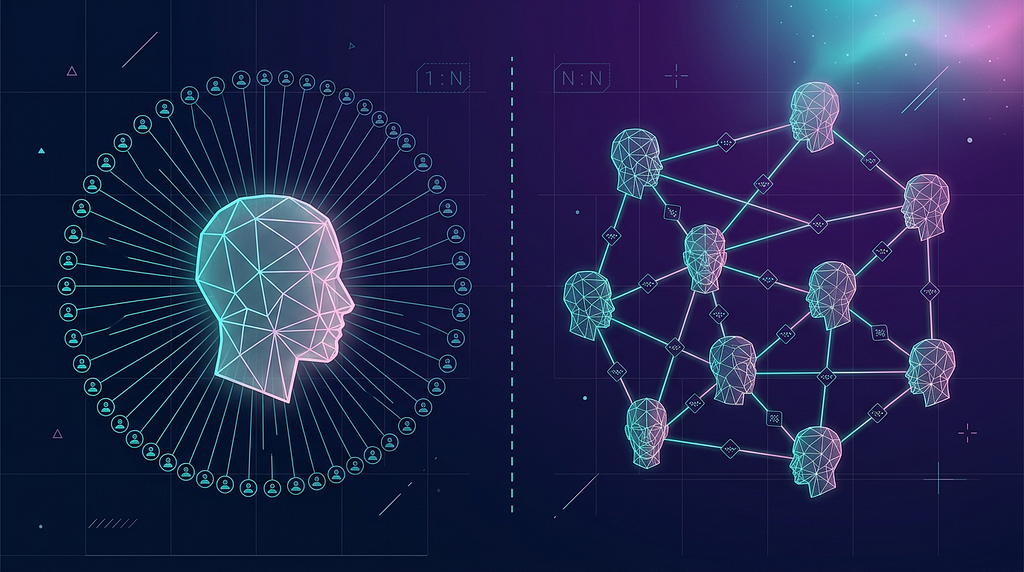
Look closely at what Meta is actually building. It’s a one-to-many object. One face, one voice, one decision-making style, aimed at 79,000 employees. Later: one creator speaking to millions of fans.
That’s the same shape of product Meta has always built. Feeds. Live streams. Reels. Stories. Broadcast media with a comment box glued to the bottom. The AI avatar is the logical endpoint of that philosophy — if the bottleneck in broadcasting was the human, remove the human. Now the broadcaster never sleeps, never gets tired, never says something that lands badly on a bad day.
From a pure capability standpoint, it’s remarkable. Photoreal video, faithful voice cloning, and a plausible-enough model of someone’s reasoning — that was a $100M research program five years ago. Today it’s a feature shipping to a social app.
From a human standpoint, though, it answers a narrow question. “How do we let the famous person reach more people?” That’s a broadcasting problem. And broadcasting has never been humanity’s actual bottleneck. We already have too much of it.
The real bottleneck is on the other side
The reason most people are exhausted online in 2026 isn’t that they can’t reach enough creators, CEOs, or celebrities. It’s that they can’t get through their own incoming stream.
Consider the math of any modern person’s day:
- A dating app presents 40–100 possible partners. Most are noise. A few are interesting. One, maybe, is the right person. You have no way to tell in advance.
- A recruiter gets 300 applications for one role. The job gets filled by whoever optimized their resume for the filter, not by whoever is actually the right fit.
- A professional networking request lands in your inbox every 90 seconds. You’d like to answer thoughtfully. You don’t. You mark them all as read at 11pm.
- The bottleneck isn’t reach. The bottleneck is match.
- Meta’s new avatar makes one more voice broadcast louder. That doesn’t solve a single one of the problems above. It arguably makes them worse — because now the “famous” side can scale its presence infinitely while the rest of us still have 24 hours and one attention span.
What an avatar should actually do
If we step back and ask what an AI avatar is for, a different answer appears.
A useful personal AI avatar is not there to talk at people on your behalf. It’s there to talk with other AI avatars on your behalf — and to come back to you with a short, honest answer:
- “Three of these forty dating candidates are worth a real conversation. Here’s why.”
- “This job posting says one thing in the description but your avatar spent ten minutes with the recruiter’s avatar and the actual culture sounds like this.”
- “Out of the 120 people at that conference, four have working problems your experience directly solves. Two of them would actually be energized meeting you.”
- That’s not a broadcaster. That’s a representative.
- A broadcaster delivers monologues. A representative negotiates, filters, asks questions, listens, and comes back with a recommendation you can accept or override. A broadcaster optimizes for output. A representative optimizes for your time.
- This is not a stylistic difference. It’s a structural one.
One avatar that speaks to many vs one avatar for everyone
Meta’s model:
One avatar → many humans. The famous person scales. Everyone else is the audience.
AvatarMatch’s model:
Every human → their own avatar → other avatars. Everyone scales equally. No audience, only participants.
In the first model, the asymmetry of attention gets worse. The CEO’s clone is available 24/7; yours never was and never will be. The influencer’s clone handles 10,000 DMs a minute; you still read yours one at a time, feeling bad about the ones you ignored.
In the second model, the asymmetry disappears. Your avatar is as available as theirs. Your avatar can negotiate with theirs. And crucially, your avatar has a job neither of Meta’s clones has: protecting your attention, not consuming someone else’s.
The job of a good avatar is saying no
This is the part that sounds strange at first. People assume an AI avatar is there to be helpful, agreeable, always-on. That’s the broadcaster instinct leaking in.
A good representative’s most valuable function is declining on your behalf. It rejects bad matches before they reach you. It ends conversations that are going nowhere. It notices when someone on the other side is misrepresenting themselves — their avatar will give that away long before they do — and it pulls the plug.
The value isn’t in the interactions it conducts. It’s in the interactions it prevents.
You see this most clearly in three places:
- Dating. Compatibility isn’t something you feel in thirty seconds of a profile. It shows up across hundreds of small decisions — how someone talks about stress, about work, about their parents, about being wrong. An avatar can sample that space in a twenty-minute simulated conversation. You can’t, not without dating the person first.
- Hiring. Interviews are theater. Both sides know it. Two avatars, primed with the real context each side wants to know, can get closer to the actual fit in fifteen minutes than a four-round human interview loop.
- Events and conferences. The useful people at any event are a small fraction of the room. Figuring out who they are currently costs you a day of awkward small talk. Two avatars can pre-negotiate that in the background before you even arrive.
- None of this requires a celebrity. None of it benefits from a famous face talking louder. It requires the opposite: a quiet, competent agent that knows you well, represents you honestly, and has the authority to say “no, not this one” on your behalf.
Why the structure matters more than the tech
Meta has better training data, more compute, more researchers, and a decade of head start on media cloning. If AI avatars were a pure technology race, the conversation would already be over.
But they’re not. The race isn’t who can render a face. The race is who can build the correct relationship between a human and their avatar, and between two avatars, and between an avatar and the social graph it lives inside.
A broadcaster’s avatar optimizes for the famous human at the center. Everyone else is throughput.
A representative’s avatar optimizes for the human it belongs to. No one is throughput. Everyone is a principal with their own agent.
These are not two versions of the same product. They are opposite answers to the question “what is an AI avatar for?”
In two years, everyone will have one
This part is not controversial anymore. Voice cloning is a consumer feature. Personality modeling from your own writing is already usable. The compute cost of running a small personal model is headed toward “included with your phone plan.” By 2028, not having a personal AI avatar will feel the way not having an email address felt in 2005.
The interesting question isn’t whether everyone will have an avatar. It’s who teaches them to meet each other.
If the answer is Meta, your avatar’s purpose will be to consume Zuckerberg’s avatar’s content more efficiently.
If the answer is something else, your avatar’s purpose will be to introduce you to the three people, out of the next thousand you could have met, who are actually worth your time.
We’re building the second one.
Primary source: Financial Times, April 13, 2026
AvatarMatch gives every person an AI representative that meets, negotiates with, and filters other people’s avatars — in dating, hiring, and events. avatarmatch.app
Comments
No comments yet — be the first.