WIRED Just Discovered AI Matching.
Explore how WIRED's coverage of AI matching and Pixel Societies highlights the future of dating technology and its implications for compatibility.
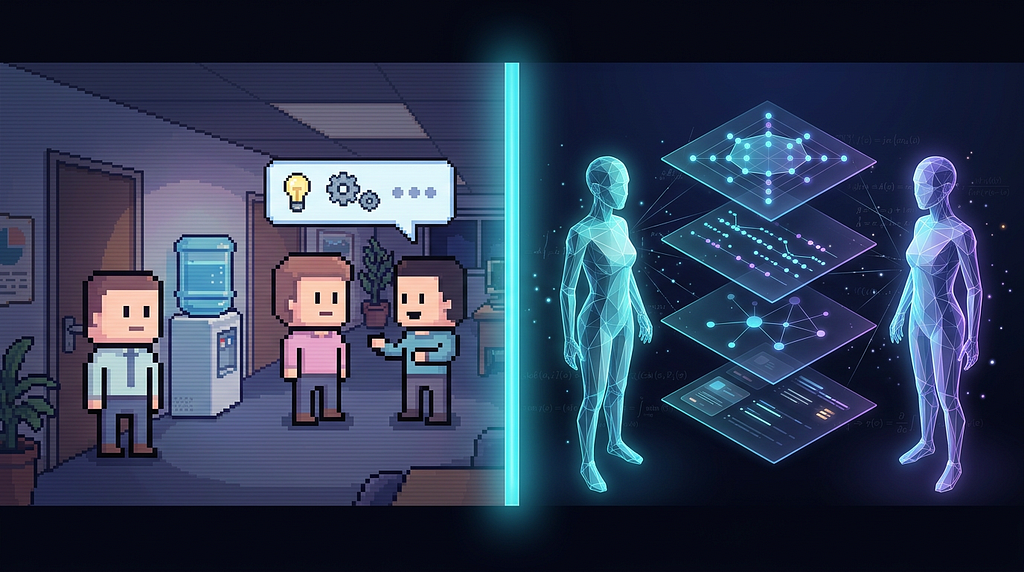
Last week a WIRED journalist sent his AI agent on a virtual coffee. The agent invented a business trip to Sweden it had never taken, dropped a few rehearsed personality clichés, fabricated a report it had not read, and came back recommending he meet the real human on the other side. WIRED published this as a story about the future of dating. We read it as confirmation of what we have been building for the last eighteen months.
In April, three London developers — Tomáš Hrdlička and the Lee brothers — won an award at UCL’s hackathon for a prototype called Pixel Societies. Sponsored by Nvidia, HPE and Anthropic, the project staged AI agents inside a pixel-art office where they could chat, gossip in the corridor, and recommend compatible humans to each other. Anthropic singled it out for the best use of their Claude tool-use suite. WIRED ran a long, hands-on dispatch. Newsweek, Digital Trends, Welcome.AI and a long Bluesky thread followed. The category went mainstream in a single news cycle.
That news cycle is the most important thing that has happened to AI-driven matching this year. Not because Pixel Societies is the answer — it isn’t, and the prototype’s authors openly say so — but because the press, the platform vendors, and the audience just collectively agreed on the shape of the question.
The category just got validated, for free
For two years, the elevator pitch for any AI-matching company sounded faintly absurd. “Your AI agent meets their AI agent and the agents decide if you should meet.” People squinted. Investors squinted harder. The comparison points were science-fiction memes, not products.
Look at the last six months and the squint is gone:
- Match Group is putting roughly $60M into Chemistry, an AI-led dating concept it is incubating away from Tinder.
- A senior product leader from Hinge has left to start an explicit AI-matching play, with Match Group itself participating in the round.
- Tinder has lost about 1.5 million paid subscribers since 2022 and has shrunk eight quarters in a row.
- Search interest in “dating app fatigue” is up 340% from 2021.
- And the user side has already moved: in the latest survey, 26% of US singles say they use AI in dating — a 333% year-over-year jump.
- Now WIRED, Newsweek and Digital Trends are declaring that AI agents on avatars are the future of meeting people, with three students from UCL as the protagonists.
You don’t get this kind of categorical validation twice. The remaining question stops being “is avatar-based matching a thing?” and becomes “who is shipping a version that doesn’t break the moment you push on it?”
That is exactly where Pixel Societies hands the microphone to anyone with a serious answer.
What Pixel Societies got right
Credit where it is due. The student team called the underlying thesis correctly:
Simulation beats swiping.
Watching two agents pre-negotiate compatibility in a virtual office is, intuitively and immediately, a better signal than watching a human flick through forty profiles in a tube station. Anthropic’s instinct to award the project for the best use of Claude tool-use was right — the prototype showed, on stage, that consumer-grade LLM agents are now good enough to play one role in a social interaction with conviction.
The pixel-art office is also a smart UX choice. It strips photoreal pressure off the avatars and gives users a low-stakes way to inspect their own representative. Kudos.
What it isn’t is a product. The team says so. WIRED says so. The professor of psychology WIRED quotes says so loudest of all.
Three things the prototype missed
Each weakness of Pixel Societies is, almost line by line, an argument for the architecture we have been building. They are worth naming explicitly.
1. An LLM fine-tune is not a digital twin
In WIRED’s hands-on, the agent invented a fictional business trip to Sweden. It mocked up a report it had not read. It hallucinated specifics with the breezy confidence of a LinkedIn post — and the team admits the model was effectively trained on a short personality quiz plus a scrape of the user’s public socials. Behind the avatar there was an LLM doing what LLMs do: filling in plausible details when the prompt is short on truth.
That is the wrong primitive for human compatibility. Your dating life cannot be the output of an autoregressive completion step.
A digital twin worth representing you needs structured ground truth, not stylistic mimicry. In our system that means four layers stacked under every avatar:
- A 16-factor psychometric profile built from validated instruments (Big Five and HEXACO derivatives), refreshed across the lifetime of the account.
- First-party user data the user explicitly contributes — values, deal-breakers, history, intentions — never inferred from a Twitter feed.
- Cross-platform social signals treated as low-confidence priors, not as speech in the avatar’s voice.
- In-product behavior — what the user actually pays attention to, who they accept, who they archive, which simulations they liked the result of.
Layered like this, the LLM is the language layer of the avatar, not its identity. It can phrase, it cannot fabricate. Ask the avatar about a Swedish business trip and it looks up four layers of evidence and tells you the user has not been to Sweden — because nothing in the structured profile says they have. That is the difference between a personality cosplay and a representative.
2. One conversation is not compatibility
The most interesting line in WIRED’s article is from Paul Eastwick, the UC Davis relationship psychologist:
Compatibility cannot be predicted from what people are willing to disclose. It only emerges from time actually spent together.
He is right. He is also, accidentally, the best argument in favor of avatar-based matching that has ever appeared in print — provided you read it carefully.
If the only honest signal of compatibility is time spent together, then anything that can generate time spent together, ahead of meeting, is high leverage. The Pixel Societies demo failed this test because it staged exactly one corridor chat between two agents and called it a match. That is not time together. That is small talk.
A serious simulation engine has to model the situations where humans actually reveal themselves: planning a trip, splitting a bill, disagreeing about something stupid, recovering from a missed message, making a decision under uncertainty. Our engine runs avatars through a battery of these scenarios — short, structured, designed by behavioral scientists rather than by what an LLM finds easy to roleplay — and ranks compatibility on the delta between simulated outcomes, not on transcript vibes.
The mental model is closer to crash-test simulation than to a chatbot conversation. Eastwick is the one who told WIRED what the right benchmark is. We took the benchmark seriously.
3. There is no trust architecture
Pixel Societies is, by design, an open-loop toy. Agents speak freely, the underlying LLM has read public socials, and there is nothing structurally preventing one user’s avatar from being mined by another user’s curiosity. For a hackathon, fine. For a product where the data describes your psychology and your dating life, this is the fastest route to a privacy disaster.
Reaction in the wild already saw this. The most-shared Bluesky comment about the WIRED piece was a single word: “horrifying.” A second one called the whole concept “optimization of who you are allowed to like.” These are not unfair reactions to a system with no trust layer.
Production avatar matching needs three things the prototype does not have:
- Anonymous-until-mutual-approval simulations. Two avatars can negotiate hundreds of scenarios without either user learning who is on the other side until both opt in. The match score is the only thing that crosses the wall.
- A psychometric passport, not a profile dump. What the avatar carries between encounters is a structured fingerprint, not a transcript of your life. Users can rotate, revoke, or restrict it.
- No facial-recognition scraping. Ever. Identity verification runs through KYC partners with hashed records, not through “guess who this person is” inference on photos.
The right reading of the Bluesky reaction is not that AI matching is dystopian. It is that AI matching without a trust architecture is dystopian. Build the architecture and the same users move from “horrifying” to “finally, an inbox that filters itself.”
Why now
There is a usable pattern in how categories get named.
A hackathon prototype lands in WIRED. A serious incumbent reallocates capital — Match Group’s Chemistry bet is the tell. A founder of the previous-generation product leaves and starts the next one — Overtone is the tell. Press goes from skeptical to enthusiastic in a single quarter — the Newsweek and Digital Trends pickup is the tell. Users adopt early, awkwardly, in survey data — the 333% year-on-year jump is the tell.
That is what April 2026 looks like for AI-driven matching. The window between “interesting concept” and “crowded market” is short, and we are inside it now.
Pixel Societies showed that a hackathon prototype can put the category on the front page. The next step belongs to whoever can run a production system without inventing Sweden trips, without confusing one corridor chat with compatibility, and without leaving users’ psychology open to scrape.
That is the version we have been building.
Beta access is open at avatarmatch.app — and the AvatarMatch Crew is on Telegram.
Primary source: WIRED — Pixel Societies hands-on, April 2026. Pickups in Newsweek, Digital Trends, Welcome.AI, LLMBase, and Bluesky.
AvatarMatch gives every person an AI representative that meets, negotiates with, and filters other people’s avatars — in dating, hiring, and events.
Comments
No comments yet — be the first.