The CIA Built AI Avatars of World Leaders. That Validates Our Category.
Explore how the CIA's AI avatars of world leaders validate the potential of avatar-based reasoning in geopolitical analysis.
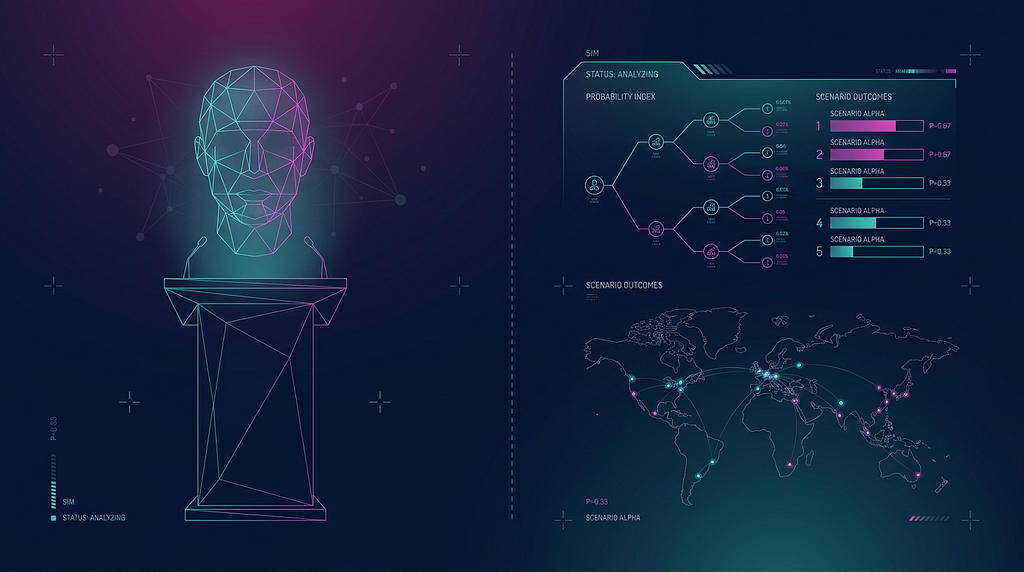
The New York Times quietly dropped one of the most important AI stories of the last two years, and most of the tech press missed it. Over roughly 2023–2025, the CIA built an AI chatbot that lets its analysts talk to simulated versions of foreign presidents and prime ministers. It is deployed. It is in production. It is used to forecast how real humans will respond to real crises.
The New York Times quietly dropped one of the most important AI stories of the last two years, and most of the tech press missed it. Over roughly 2023–2025, the CIA built an AI chatbot that lets its analysts talk to simulated versions of foreign presidents and prime ministers. It is deployed. It is in production. It is used to forecast how real humans will respond to real crises.
This is not a speculative research paper. This is the intelligence service of the United States, shipping LLM-powered avatars of world leaders into live analytical workflows. For anyone building in the personal-avatar category, that is the single clearest external validation you could ask for.
What the CIA actually built
The tool lets an analyst hand a hypothetical to a virtual twin of a specific leader — new sanctions, a border incident, a trade ultimatum — and read back a modeled response in that leader’s reasoning style. According to reporting by Julian E. Barnes in the NYT (paywalled; open reposts at The Star and Times of India), the system is trained on a combination of classified intelligence and open-source material, and it updates continuously — if a leader publicly shifts position, the model adapts.
Two other details matter, reported by WION:
- The system runs thousands of simulations in parallel and ranks outcomes by likelihood.
- It is not a vanity prototype. It is an everyday analytical instrument.
Futurism notes that while the CIA will not disclose scope, the tool is already operational.
Who built it, and why that matters
The person behind the push is Nand Mulchandani, the CIA’s first-ever CTO. Before the Agency, he ran the Pentagon’s Joint Artificial Intelligence Center. He describes the chatbot as a “fantastic example of an app that we were able to rapidly deploy and get out to production in a cheaper, faster fashion.” Translation, from someone who ships for a living: this is not a decade-long moonshot. This is a modern LLM stack applied to a narrow, important problem, and shipped.
The institutional sponsor was William Burns, CIA director 2021–2025, who made a strategic bet on a technology transformation of the Agency. His successor under the Trump administration, John Ratcliffe, explicitly committed to expanding the program: “The nation who wins the race in the emerging technologies of today will dominate the world of tomorrow.”
The Agency quietly started looking like a startup
The CIA story is not just a product story. It is an operating-model story. In the last few years, the Agency:
- Stood up a dedicated tech mission center focused on China and other adversaries’ technologies.
- Redesigned its offices to look like Silicon Valley — open floor plans, mobile desks — as a deliberate signal to startups that the Agency is a plausible partner.
- Continues to fund startups through In-Q-Tel, its 25-year-old venture arm whose portfolio includes Palantir and the company that became Google Earth.
- Began declassifying selected problems so private firms can bid on them without a clearance.
The message is simple. If your company can model humans, the intelligence community wants to talk.
What this means for the avatar-based reasoning category
Strip the geopolitics away and look at the primitive.
What the CIA built is an LLM avatar of a specific human, trained on everything known about that person, used to reason through hypothetical situations and output a probabilistic behavioral forecast. The Agency then scales that with thousands of parallel simulations and ranks the outcomes.
That sentence is the entire category we are in. The only difference is the domain:
- CIA: Xi, Putin, Modi, Netanyahu. Stakes: sanctions, war, treaties.
- AvatarMatch: you, a possible partner, a possible co-founder, a possible hire. Stakes: the next five years of your life.
For two years, the honest answer to “can an LLM avatar give you a useful forecast of a real person’s behavior?” was a mix of demos, memes, and hope. Now the answer is: yes, to a standard the US intelligence community will stake national-security decisions on.
That is the validation point. It is not the conspiratorial version of this story — the idea that “every US decision is run through a bot” is not in the source material and should be left alone; it makes the serious case sound silly. The serious case stands on its own:
Avatar-based reasoning has left the meme phase. It is in production, in an environment where being wrong is expensive, inside an institution that does not ship toys.
Where we go from here
The CIA’s use case is one-sided: the analyst interacts with a modeled adversary, the adversary does not know the model exists. That is appropriate for intelligence. It is the wrong shape for civilian life.
In civilian life — dating, hiring, teams, introductions — the version that matters is symmetric. Your avatar talks to their avatar. Both sides are represented. Both sides set constraints. Both sides get a ranked, honest answer back: “this is worth your time” or “this isn’t.”
The underlying tech is now the same tech the Agency trusts with a president’s calendar. The question for the next two years is no longer whether it works. It is who gets to use it, on whose behalf, and with what permissions.
We’re building the civilian, symmetric version. If the last two years convinced the CIA, the next two will convince everyone else.
Primary source: Julian E. Barnes, “C.I.A.’s Chatbot Stands In for World Leaders,” NYT, 18 Jan 2025 (paywalled; open reposts at The Star and Times of India).
AvatarMatch gives every person an AI representative that meets, negotiates with, and filters other people’s avatars — in dating, hiring, and events. avatarmatch.app
Comments
No comments yet — be the first.