Nash Equilibrium for Modeling Employee Behavior in Teams
A rigorous exploration of how game theory and Nash Equilibrium can model individual decisions within teams, predict team dynamics, and inform AI-driven matching systems.
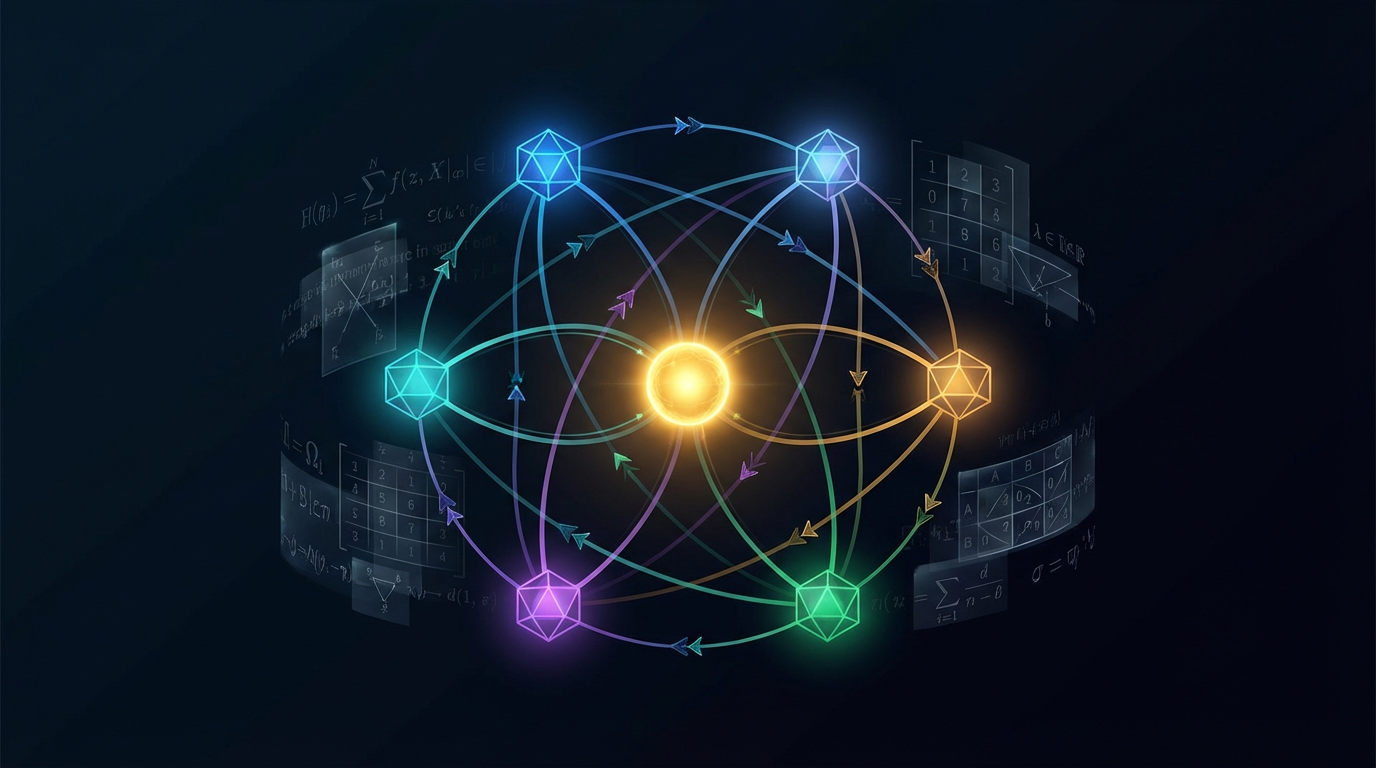
When we build teams — whether for startups, corporate projects, or dating — we're assembling a system of interacting rational agents. Each person makes decisions that depend on what everyone else does. This is, by definition, a game.
Game theory gives us precise tools to analyze these situations. The most powerful: Nash Equilibrium — the state where no individual can improve their outcome by unilaterally changing their strategy, given what everyone else is doing.
This article explores how Nash Equilibrium applies to team dynamics and how it can inform AI-driven team composition and matching.
1. Foundations: What Is Nash Equilibrium?
The Formal Definition
A Nash Equilibrium (NE) is a strategy profile s* = (s₁*, s₂*, ..., sₙ*) where for every player i:
uᵢ(sᵢ*, s₋ᵢ*) ≥ uᵢ(sᵢ, s₋ᵢ*) for all sᵢ ∈ Sᵢ
In plain language: given what everyone else is doing, no one has an incentive to deviate.
Key Properties
| Property | Implication for Teams |
|---|---|
| Stability | Once reached, the equilibrium self-sustains without external enforcement |
| Multiplicity | Teams may have several equilibria — some productive, some dysfunctional |
| Inefficiency | The equilibrium may NOT be the best possible outcome (cf. Prisoner's Dilemma) |
| Mixed strategies | Players may randomize — modeling inconsistent or unpredictable behavior |
Why It Matters for Teams
Traditional team models treat people as components. Game theory treats them as strategic agents — each with their own goals, information, and decision-making. This is closer to reality.
2. The Team as an N-Player Game
Defining the Game
A team of n members can be modeled as a game G = (N, S, u) where:
- N = {1, 2, ..., n} — the set of team members
- Sᵢ — the strategy set of player i (e.g., effort level, communication style, cooperation vs. free-riding)
- uᵢ: S₁ × S₂ × ... × Sₙ → ℝ — player i's payoff function
What Are "Strategies" in a Team Context?
Unlike chess, team strategies are continuous and multidimensional:
| Strategy Dimension | Low End | High End |
|---|---|---|
| Effort | Minimum viable | Going above and beyond |
| Knowledge sharing | Hoarding information | Open documentation |
| Conflict approach | Avoidance | Direct confrontation |
| Initiative | Wait for instructions | Proactive proposals |
| Risk tolerance | Conservative | Experimental |
Each team member continuously chooses a point along each dimension, forming their strategy vector.

The Payoff Function
A team member's payoff depends on:
- Direct reward — salary, bonus, recognition
- Peer effects — how others' strategies affect your outcome
- Team output — shared success or failure
- Private costs — effort, stress, opportunity cost
A simplified payoff for player i:
uᵢ = αᵢ · f(e₁, e₂, ..., eₙ) − cᵢ(eᵢ) + βᵢ · g(eᵢ, e₋ᵢ)
Where:
- f(·) — team production function (depends on everyone's effort)
- cᵢ(eᵢ) — private cost of effort for player i
- g(·) — peer interaction effects (synergy or friction)
- αᵢ — player i's share of team output
- βᵢ — sensitivity to peer dynamics
3. Classic Team Pathologies as Nash Equilibria
3.1 The Free-Rider Equilibrium
Setup: A team where output is shared equally regardless of individual contribution.
If the team production function has diminishing returns and costs are private, the NE often has everyone contributing less than the social optimum. Each person thinks: "My marginal contribution is diluted across n people, but I bear the full cost."
Formal condition for free-riding NE:
When ∂f/∂eᵢ · (1/n) < ∂cᵢ/∂eᵢ at the efficient effort level, the equilibrium effort is below optimal.
Real-world example: A 10-person team on a shared project with no individual accountability metrics. Five members do 80% of the work; five coast.
This is a stable Nash Equilibrium — no single free-rider has incentive to start working harder (their extra effort is diluted), and no hard worker has incentive to work even harder (they're already bearing disproportionate cost).
3.2 The Coordination Failure Equilibrium
Setup: Two approaches to a problem (say, microservices vs. monolith). Each is viable, but mixing them is disastrous.
This is a coordination game with two pure-strategy Nash Equilibria:
| Developer B: Microservices | Developer B: Monolith | |
|---|---|---|
| Developer A: Microservices | (8, 8) ← NE₁ | (2, 2) |
| Developer A: Monolith | (2, 2) | (7, 7) ← NE₂ |
Both (Microservices, Microservices) and (Monolith, Monolith) are Nash Equilibria. The problem isn't that people are selfish — it's that they might converge on different equilibria, ending up at (2, 2).
This is why team alignment matters more than individual talent.
3.3 The Hawk-Dove Equilibrium (Office Politics)
Setup: Two team members competing for a leadership role or resource.
| Person B: Aggressive | Person B: Cooperative | |
|---|---|---|
| Person A: Aggressive | (-5, -5) | (10, 2) |
| Person A: Cooperative | (2, 10) | (6, 6) |
The (Cooperative, Cooperative) outcome is best for the team but is not a Nash Equilibrium — each player can gain by switching to Aggressive. The NE in mixed strategies has both players being aggressive with some probability, leading to expected payoffs below (6, 6).
This models office politics: the stable outcome is worse than what cooperation would achieve.
4. Multi-Dimensional Equilibrium Analysis
Real teams don't play one-shot games. They interact across multiple dimensions simultaneously.
The Compound Strategy Space
A team member's strategy is a vector:
sᵢ = (effort, communication, initiative, risk, cooperation)
The Nash Equilibrium of the compound game may be very different from the equilibria of each dimension analyzed separately. This is because dimensions interact:
- High effort + low communication = wasted work
- High initiative + low cooperation = chaos
- High risk tolerance + low trust = conflict
Complementarities and Substitutes
Two strategy dimensions are complementary if increasing one raises the marginal return of the other. For example:
- Communication and cooperation are complements — sharing information is more valuable when people act on it cooperatively
- Effort and initiative may be substitutes — a person who works extremely hard on assigned tasks may not need to be proactive
Key insight: Teams with complementary strategy profiles tend to have higher-payoff equilibria. Teams with substitute profiles get stuck in mediocre equilibria.

5. Dynamic Games: Repeated Interaction
Teams don't play once — they interact repeatedly. This changes everything.
The Folk Theorem
In infinitely repeated games with sufficiently patient players, any individually rational payoff can be sustained as a Nash Equilibrium.
Translation: If team members care about the future enough, cooperation becomes self-sustaining. The threat of future punishment (withdrawal of cooperation) keeps everyone honest.
Trigger Strategies in Teams
Common punishment mechanisms in real teams:
| Strategy | Mechanism | Stability |
|---|---|---|
| Grim trigger | Defect forever after first defection | Stable but fragile |
| Tit-for-tat | Mirror the other's previous action | Stable and forgiving |
| Graduated response | Mild punishment first, escalate if repeated | Most realistic |
The Shadow of the Future
Cooperation is easier to sustain when:
- δ (discount factor) is high — people value future interactions (long-term teams)
- The game is likely to continue — no known end date
- Actions are observable — transparent work environments
- Punishment is credible — there are real consequences for defection
Implication for team design: Short-term project teams with no future interaction are prone to free-riding. Long-term teams with transparent processes sustain cooperation naturally.
6. Incomplete Information: Bayesian Nash Equilibrium
In reality, team members don't fully know each other's:
- Skill levels
- Motivation (intrinsic vs. extrinsic)
- Risk preferences
- Outside options
This calls for Bayesian Nash Equilibrium (BNE) — where each player maximizes expected payoff given their beliefs about others' types.
Type Spaces in Teams
Each member has a type θᵢ drawn from a distribution, representing their hidden characteristics:
θᵢ = (skill, motivation, risk_preference, cooperation_tendency)
A BNE is a strategy profile where each player's strategy is optimal given their type and their beliefs about others' types:
sᵢ*(θᵢ) = argmax E[uᵢ(sᵢ, s₋ᵢ*(θ₋ᵢ)) | θᵢ]
Signaling and Screening
In teams, people signal their types through observable actions:
- Working late → signals high effort type (or anxiety type)
- Asking questions → signals either curiosity or incompetence (ambiguous signal)
- Taking initiative → signals leadership type
A well-designed team environment makes productive types easier to signal and reduces ambiguity.
Why This Matters for AI Matching
If we can estimate θᵢ through psychometric testing and behavioral analysis (which AvatarMatch does via avatar conversations), we can:
- Predict the likely BNE of a proposed team
- Identify teams where the BNE is productive vs. dysfunctional
- Design incentive structures that shift the BNE toward better outcomes
7. Mechanism Design: Engineering Better Equilibria
If Nash Equilibrium tells us what will happen, mechanism design tells us how to make better things happen. It's game theory in reverse.
The Team Designer's Problem
Given a set of potential team members with types θ = (θ₁, ..., θₙ), design:
- Team composition — which subset of players to include
- Rules/incentives — the payoff structure
- Information structure — what each player knows about others
...such that the resulting Nash Equilibrium maximizes team output.
Practical Mechanisms
| Mechanism | Effect on Equilibrium |
|---|---|
| Individual performance metrics | Reduces free-riding by making effort observable |
| Peer evaluation | Creates accountability through mutual monitoring |
| Profit sharing | Aligns individual and team incentives (but enables free-riding in large teams) |
| Role specialization | Reduces coordination failures by making strategies complementary |
| Transparent communication tools | Increases information, moving toward complete-info NE |
| Psychological safety norms | Changes payoff structure to make cooperation dominant |
The VCG Mechanism for Teams
The Vickrey-Clarke-Groves mechanism can theoretically achieve efficient outcomes even with self-interested agents:
Each player is paid their marginal contribution to total team output:
transferᵢ = f(s*) − f(s*₋ᵢ)
Where f(s*₋ᵢ) is the team output without player i. This makes truth-telling and full effort a dominant strategy — a much stronger solution than NE.
Practical challenge: Measuring marginal contribution precisely is hard. But approximations (like comparing team performance with and without a member) can get close.
8. Computational Approaches
Finding Nash Equilibria in Team Games
For small teams (2-4 players), NE can be computed analytically. For larger teams, we need algorithms:
| Method | Complexity | Use Case |
|---|---|---|
| Support enumeration | Exponential | Small games, exact solutions |
| Lemke-Howson | Polynomial (2-player) | Bimatrix games |
| Fictitious play | Iterative | Large games, approximate NE |
| Replicator dynamics | Continuous | Evolutionary stable strategies |
| Deep reinforcement learning | Variable | Complex multi-agent settings |
Agent-Based Simulation
For teams of 5+ with continuous strategy spaces, agent-based simulation is often the most practical approach:
- Initialize agents with estimated types (from psychometric data)
- Each agent plays a best-response to the current strategy profile
- Iterate until convergence (= Nash Equilibrium)
- Record the equilibrium payoffs for the team
By running this across many possible team compositions, we can rank teams by their equilibrium quality.
9. Application to AvatarMatch: Team Composition Engine
The Pipeline
Psychometric profiles (θᵢ)
    ↓
Estimate payoff functions (uᵢ)
    ↓
For each candidate team:
    Simulate → Find NE → Score team
    ↓
Rank teams by equilibrium quality
    ↓
Recommend optimal composition
What Psychometric Data Maps To
| Psychometric Dimension | Game Theory Parameter |
|---|---|
| Big Five: Agreeableness | Cooperation tendency (βᵢ) |
| Big Five: Conscientiousness | Effort cost function (cᵢ) |
| Big Five: Openness | Strategy space breadth (Sᵢ) |
| Risk tolerance (DOSPERT) | Risk dimension of strategy vector |
| Communication style | Information structure of the game |
| Values alignment | Payoff function correlation |
Predicting Team Equilibria
Given a proposed team of n members with known types, the system:
- Constructs the game — strategy spaces and payoff functions parameterized by psychometric data
- Finds equilibria — using fictitious play or reinforcement learning agents
- Evaluates stability — how robust is the NE to small perturbations?
- Scores the team — based on total equilibrium payoff, fairness (variance of individual payoffs), and robustness
Example: 4-Person Engineering Team
Consider assembling a team from candidates A, B, C, D, E with estimated types:
| Candidate | Effort Cost | Cooperation | Initiative | Risk |
|---|---|---|---|---|
| A | Low | High | High | Medium |
| B | Medium | High | Medium | Low |
| C | Low | Low | High | High |
| D | High | Medium | Low | Low |
| E | Medium | Medium | High | Medium |
Team {A, B, C, E} simulation converges to a high-output NE where:
- A and E take initiative, B cooperates and supports, C pushes boundaries
- Equilibrium effort: 82% of theoretical maximum
Team {A, B, D, E} simulation converges to a mediocre NE:
- D's high effort cost creates a free-riding equilibrium
- Others reduce effort to compensate
- Equilibrium effort: 61% of theoretical maximum
The difference isn't that D is "bad" — it's that D shifts the equilibrium.
10. Limitations and Open Problems
What Nash Equilibrium Doesn't Capture
- Bounded rationality — people don't compute optimal strategies; they use heuristics
- Emotions — anger, loyalty, and pride aren't easily modeled as payoffs
- Learning — new team members learn and adapt, changing the game over time
- Power dynamics — not all players have equal strategic weight
- Culture — shared norms change the feasible strategy set in ways that are hard to formalize
Extensions Worth Exploring
- Quantal Response Equilibrium (QRE) — models bounded rationality by allowing "noisy" best responses
- Correlated Equilibrium — a mediator (like a manager or AI) can recommend strategies, achieving outcomes better than any NE
- Evolutionary Game Theory — models how team norms and behaviors evolve over time
- Cooperative Game Theory (Shapley Value) — assigns fair credit for team output to individuals
The Correlated Equilibrium Opportunity
A correlated equilibrium allows a trusted mediator to recommend private strategies to each player. The recommended profile can achieve payoffs outside the convex hull of Nash Equilibria — strictly better outcomes.
This is the theoretical foundation for AI-mediated team management. An AI system that observes team dynamics and privately recommends actions to each member can sustain cooperation levels that no self-organizing team could achieve.
Conclusion
Nash Equilibrium provides a rigorous framework for understanding why teams behave the way they do — and why talented individuals sometimes form dysfunctional teams.
The key insights for team design:
- Team output is determined by the equilibrium, not by the sum of individual abilities
- Multiple equilibria exist — team composition and incentives select which one emerges
- Complementary types produce higher-payoff equilibria than collections of similar stars
- Long-term interaction sustains cooperation through repeated game dynamics
- AI can serve as a correlation device — recommending strategies that no individual would choose alone but that are collectively superior
For AvatarMatch, this means the matching engine isn't just finding "compatible" people — it's predicting and optimizing the Nash Equilibrium of the resulting team.
This article is part of AvatarMatch's research into game-theoretic foundations for human matching. The concepts described here inform our team composition and compatibility scoring algorithms.
Comments
No comments yet — be the first.