MBTI and relationship compatibility: what research says
How Myers-Briggs types relate to couple fit — and why AvatarMatch goes beyond classic typology.
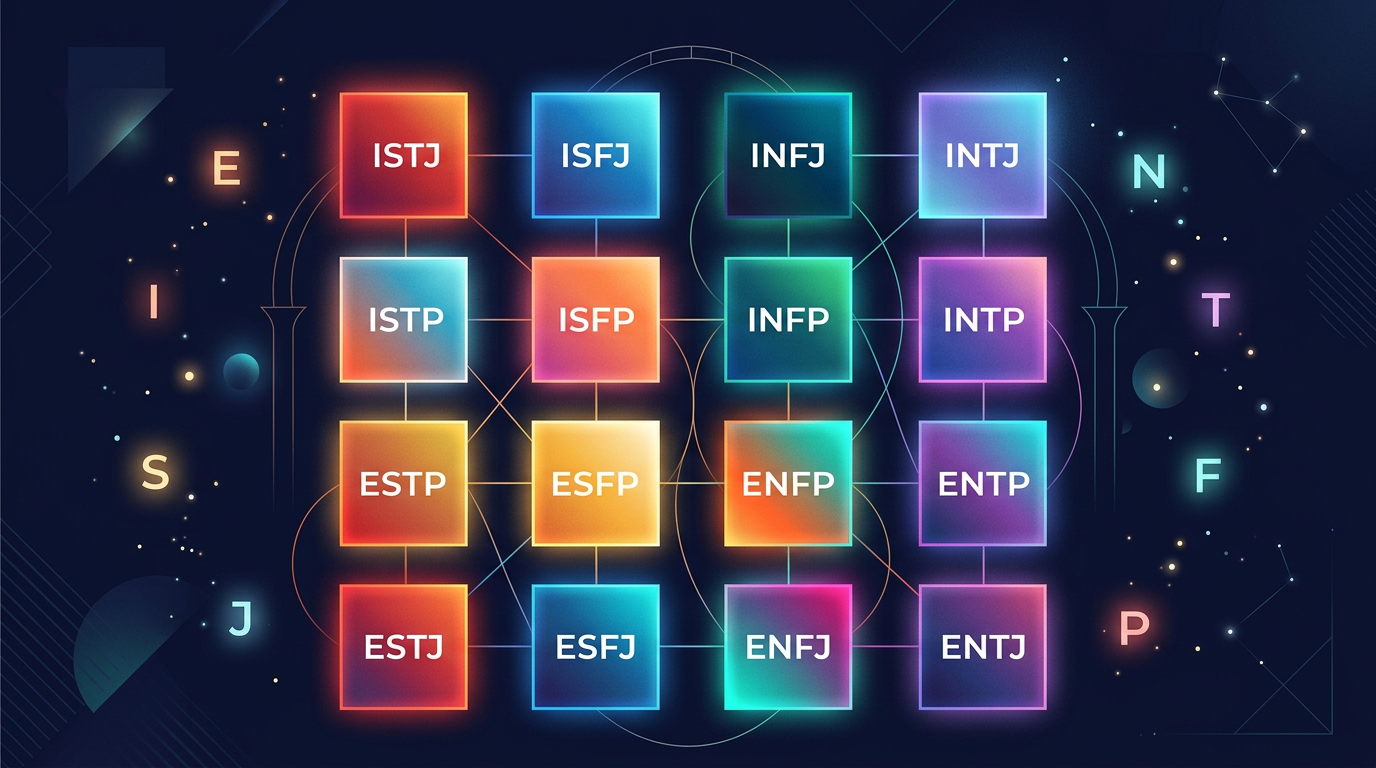
“You’re INFJ? We’re a perfect match!” Sound familiar? MBTI has become a dating-culture staple. But how well does it really predict compatibility?
MBTI in brief
The Myers-Briggs Type Indicator maps 16 types along four axes:
- E/I — Extraversion / Introversion
- S/N — Sensing / Intuition
- T/F — Thinking / Feeling
- J/P — Judging / Perceiving
Combinations yield types like ENFP, ISTJ, INFJ, and so on.
MBTI and relationships: the evidence
Research paints a mixed picture.
What tends to help:
- Similar E/I levels often predict communication satisfaction
- S/N alignment can make everyday decisions easier
- Shared T/F understanding can reduce friction in emotional situations
What doesn’t hold up:
- MBTI does not predict long-term relationship satisfaction
- Types aren’t stable — many people get different results on retest
- Sixteen buckets are too coarse for real personality complexity
Why AvatarMatch goes further
MBTI is a starting point, not the finish line. We use:
| Dimension | MBTI | AvatarMatch |
|---|---|---|
| Personality model | Four dichotomies | Big Five + additional axes |
| Communication style | Not measured | Analysis of real dialogue |
| Values | Not measured | Deep values profile |
| Conflict | Not measured | Scenario-based testing |
| Validity | Debated | Grounded in peer-reviewed models |
Instead of a four-letter label, we build a multi-dimensional portrait and test fit through live avatar interaction.
Using MBTI wisely
- As orientation — it can clarify communication preferences
- Not as a filter — don’t reject people by type alone
- With other tools — Big Five, attachment theory, love languages
Takeaway
MBTI is a useful metaphor but a weak compatibility predictor. Real fit is proven in interaction, not letters.
Comments
No comments yet — be the first.